

When we think about plastic pollution, we usually picture visible debris scattered across land or floating on ocean waters.
Because larger plastic waste is easy to spot, we tend to assume that our food supply remains untainted by synthetic packaging.
However, focusing only on large packaging waste overlooks a far more pervasive issue: plastic waste continually breaks down into microscopic fragments that contaminate our global agricultural soils, livestock feeds, seafood networks, and processed dietary staples. Microplastics and nanoplastics are no longer just environmental pollutants—they are a daily dietary variable in the human diet.
AquaLia says: “Plastic isn’t just sitting in landfills anymore. It’s on our dinner plates, sprinkled in our table salt, and absorbed straight into the fruits and vegetables we eat every single day!”
To understand how synthetic particles enter our food supply, we have to look closely at how micro-polymers travel through agricultural and culinary systems:
- Agricultural Soil Absorption and Plant Uptake: According to landmark research published in Nature Sustainability by scientists at the Chinese Academy of Sciences and the University of Leiden, nanoplastic and microplastic particles in agricultural soil are absorbed directly through crop root systems, traveling upward into the edible tissues of everyday vegetables like apples, carrots, and lettuce.
- Seafood and Marine Food Web Bioaccumulation: Research published in Environmental Science & Technology confirms that marine species regularly consume floating microplastic particles. Filter feeders like mussels, oysters, and shrimp digest synthetic fibers, transferring microplastics directly to human consumers when eaten whole.
- Ubiquitous Dietary Staples and Processing Contamination: A comprehensive dietary study published in Environmental Science & Technology estimates that the average adult ingests between 39,000 to 52,000 microplastic particles annually through food alone—a figure that jumps significantly when accounting for single-use bottled beverages and plastic-packaged processed foods.
When we combine these scientific findings, the conclusion is clear: single-use plastic packaging is actively contaminating our global food chain from farm to table.
AquaLia says: “We can’t solve dietary plastic contamination while continuing to wrap every single drink and meal in disposable packaging. To stop eating plastic, we have to stop packing our lives in it!”
This creates an urgent challenge for conscious consumers. Continuing to buy single-use pre-packaged drinks and foods fuels the ongoing cycle of plastic production and breakdown, increasing the total volume of microplastics entering our soil and water networks.
Real protection requires cutting off single-use plastic packaging right at the source.
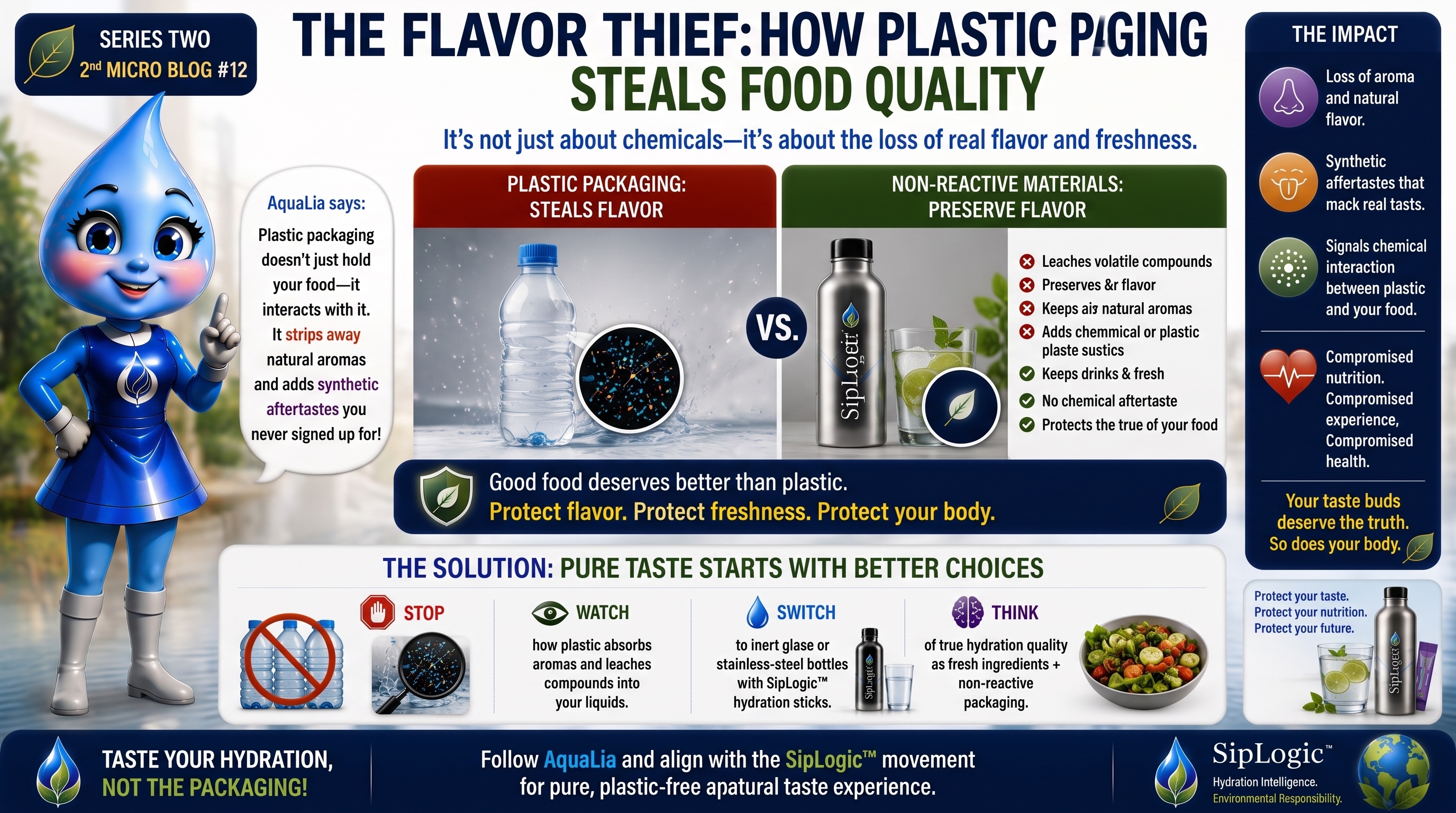
Why Follow This Matters: We cannot safeguard our food supply while constantly purchasing disposable plastic containers. Through SipLogic, and with AquaLia’s guidance, we eliminate the need for factory-blown plastic packaging entirely. By using compact, plastic-free hydration powder sticks mixed into a reusable glass or stainless-steel bottle, you help stop the continuous flow of synthetic packaging into our agricultural and aquatic environments.
AquaLia says: “Protect your plate by changing your bottle! Ditch single-use plastic packaging, hydrate with plastic-free powder sticks, and keep synthetic polymers out of our shared food supply!”
Simple Shift: True wellness means protecting what goes into your body. Switching to lightweight powder concentrates in durable, non-plastic containers helps reduce global plastic waste and protects our food chain from synthetic contamination.
call to action
Action Step: Audit your daily food and drink packaging choices. Replace single-use plastic beverage bottles with a non-leaching glass or stainless-steel container paired with SipLogic plastic-free hydration sticks to reduce your overall contribution to agricultural plastic pollution.
Core Principle: Food safety is not just about organic ingredients—it is about eliminating microplastic contamination across the entire supply chain.
Follow us for more solutions: Join the SipLogic movement. Follow AquaLia for clear breakdowns of environmental metrics, low-waste lifestyle strategies, and zero-plastic hydration tips.



Leave a Reply